Part of: Agentic AI for Construction
December 2025
Build-to-spec data centers are dead
The physical world is being redesigned for AI — Part 2
What replaces it? Scaling in Time.
For decades, data center construction followed one rule: finalize the specs, then build.
Design-build. Fast-track. Modular. Different methods — same assumption.
You’d eventually lock the endpoint.
AI compute just killed that assumption.
There is no endpoint anymore.
The timeline broke:
→ GPU refresh cycle: 12-18 months → Data center construction: 24-36 months → By the time you’re done, the chip has changed twice
Nvidia’s roadmap proves it:
→ Now: Blackwell GB200 → Late 2025: Blackwell Ultra B300 — different power, different cooling → Late 2026: Rubin — different power, different cooling → Late 2027: Rubin Ultra — different power, different cooling
Four generations in three years.
Why it breaks:
You break ground today for GB200.
Month 12: Building 50% complete. Blackwell Ultra ships. Already last-gen.
Month 18: Rubin ships. Different power. Different cooling.
Month 24: Building opens — optimized for hardware two generations behind.
You just spent $800M on a facility designed for an obsolete chip.
The old way worked when chip cycles were 5-7 years.
At 12-18 months, it’s impossible.
So how do you build for a chip that doesn’t exist yet?
Scaling in Time — and Microsoft is already doing it.
They call the unit that makes this possible a “cell.”
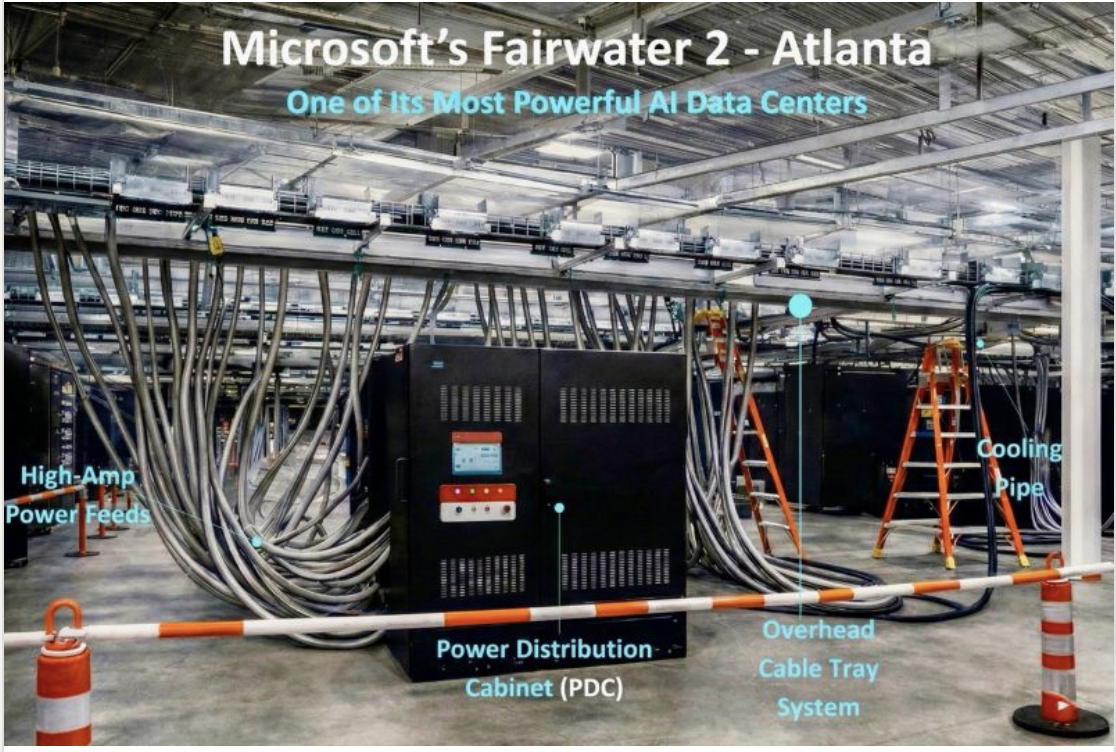
I watched Microsoft executives tour Fairwater 2 in Atlanta.
They walked into a cell. Everything finished:
→ Cooling loops installed → Power busways in place (800V DC ready) → Fiber trunks connected → Floors reinforced for 3,000+ lb racks
But no racks. No servers.
Some cells are running. Others are waiting for next-gen chips.
The cell is the buffer — it lets them wait for Rubin Ultra without stalling the build.
Satya Nadella: “You don’t want to build to one fixed spec. You want to be scaling in time, not scale once and get stuck.”
What “Scaling in Time” means:
→ Build the backbone early → Leave the last mile open → Defer final decisions as long as possible → Fit-out at the last responsible moment
You’re not building for a spec anymore. You’re building for optionality.
What this breaks in construction:
→ Procurement can’t lock equipment too early → Mechanical installs backbone, pauses terminations → Electrical installs busbars, not final connections → Schedules must absorb uncertainty, not eliminate it
This isn’t poor planning. It’s adaptive planning.
The contractors who understand this will dominate hyperscale.
The ones who bid like traditional data centers will get burned.
The physical world is being redesigned for AI.
Originally published on LinkedIn, December 17, 2025.