Part of: Agentic AI for Construction
January 2026
The purchase order is a lie
The physical world is being redesigned for AI — Part 6
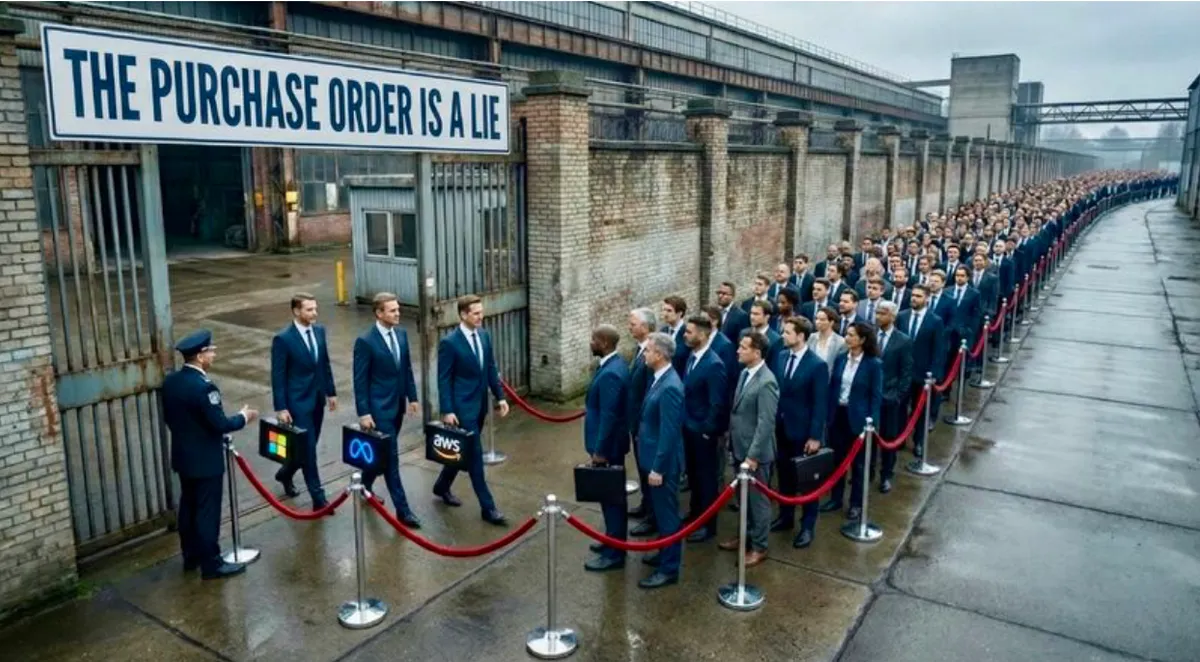
Microsoft reserved transformer capacity in 2023. You sent a PO in 2025. You’re not competing. You’re waiting.
For decades, procurement followed one rule: need it, spec it, order it, receive it.
AI infrastructure just killed that sequence.
The math broke:
→ Transformer lead time: 80-144 weeks
→ Off-the-shelf CAT generator: 18 months
→ Utility interconnect: 4-7 years
→ Your schedule: 52 weeks
You can’t fit 144 weeks into 52.
Why it broke:
It’s a visibility problem.
Your schedule shows what YOU control. It doesn’t show the invisible queue — transformer steel allocations, vendor shop floor capacity, utility positions locked years before you broke ground.
Schedule lives in P6. Procurement lives in spreadsheets. Vendor status lives in someone’s head.
Nothing talks to anything.
A 6-week slip discovered at Week 40 costs $8M and a missed energization date.
Discovered at Week 4? A phone call.
What’s replacing it:
Not better spreadsheets. Not more status meetings.
A detection layer that sees the slip — and offers you options while you still have leverage.
Week 4. The system flags your transformer delivery drifting from Week 52 to Week 58.
It doesn’t just alert you. It shows you moves:
→ Secondary market — European suppliers showing 60-week lead times vs. 80 domestic
→ Portfolio reallocation — Site B has power ready, Site A doesn’t, move the unit
→ Resequence commissioning — protect energization, absorb the slip in early works
→ Design to available — spec the switchgear that ships in 40 weeks, not the one that’s 70
Cost and time attached to each option. You pick. The system replans.
At Week 40, those options don’t exist.
Detect → Aware → Option Routes → Decide.
Collection is human. Awareness is AI. Decision is human.
What this means for construction:
→ Procurement becomes the first workstream, not downstream
→ Site selection follows equipment availability, not real estate
→ Weekly status meetings become decision meetings
→ The second site runs faster — because the system learns
The teams that see the queue early will outmaneuver the teams running on assumptions.
The rest will explain to their boards why the building is done and the GPUs are still in a warehouse.
Originally published on LinkedIn, January 27, 2026.