Part of: Agentic AI for Construction
January 2026
The Gantt chart is dead
The physical world is being redesigned for AI — Part 5
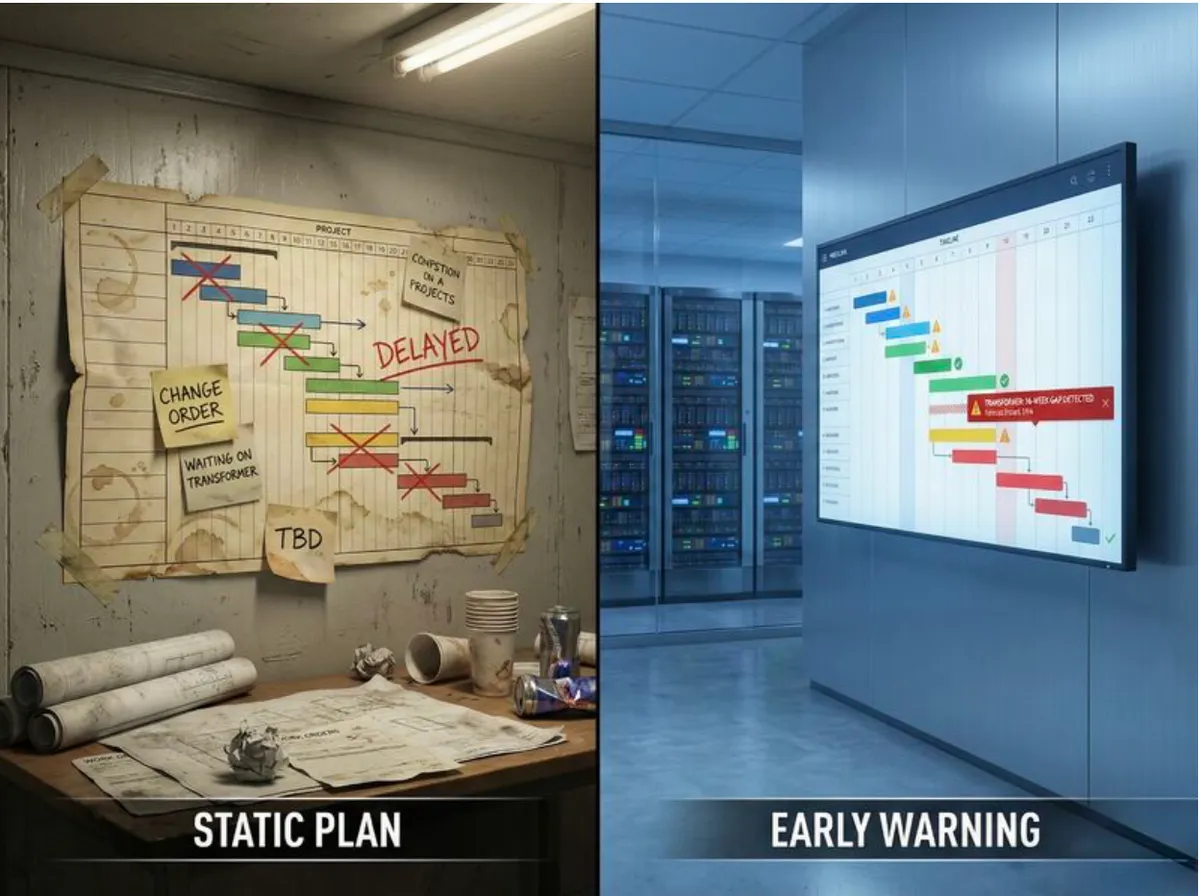
The Gantt chart has been the standard since 1910.
But AI infrastructure just broke the assumptions underneath it.
The math changed:
→ Legacy data center build: 18–24 months, plan once, execute sequentially
→ Speed of Light execution: 12 months, plan continuously, execute in parallel
→ GPU refresh cycle: 12–18 months — your “plan” is obsolete before groundbreaking
Jensen Huang: “We don’t do a periodic planning system. The world is a living, breathing thing. So we just plan continuously.”
It’s a coordination requirement.
Why it broke:
It’s a physics problem.
A Gantt chart is a promise: that the future can be locked into a sequence and managed through updates.
That only works when the world moves slowly enough that:
→ assumptions stay stable
→ dependencies don’t mutate
→ humans notice drift before it compounds
AI data centers move too fast for that.
The constraint isn’t “scheduling.” The constraint is that reality changes between updates.
The chip cycle proves it.
NVIDIA’s roadmap is now faster than construction:
→ 2024: Blackwell GB200
→ 2025: Blackwell Ultra B300
→ 2026: Vera Rubin
→ 2027: Rubin Ultra
Four chips. Four years. Each one changes the building.
You break ground in January for Blackwell Ultra at ~1,200 watts per chip. By your November opening, Vera Rubin needs ~1,500 watts.
Now your power distribution is undersized. Your cooling loops can’t dissipate the heat. Your $800M facility is optimized for a chip you can’t buy anymore.
A static plan can’t absorb a moving target.
So what replaces it?
Not “better charts.” Not “real-time Gantt.” Not more status meetings.
The replacement is a different operating model:
Stop managing the story. Start detecting the system.
Detection means weak signals surface before they become visible failures:
→ Transformer delivery date moves — flagged in hours, not weeks
→ Switchgear spec doesn’t match the PO — caught before fabrication, not at delivery
→ Concrete pour slips — the downstream trade stack is predicted, not discovered on-site
→ The 16-week gap between transformer arrival and energization — flagged on Day 1, not Day 180
This is the difference:
A 6-week transformer slip discovered at week 40 costs $8M and a missed energization date.
Discovered at week 4, it costs a phone call.
What this means for construction:
→ Weekly status meetings become decision meetings — the system does the chasing
→ Procurement and schedule reconcile continuously, not through RFI cycles
→ Recovery paths surface while you still have leverage
→ The second site runs faster than the first — because the system learns
This isn’t a chart anymore.
It’s an early-warning layer for physical execution risk.
The teams who detect problems at week 4 will build the AI era.
The rest will report why they’re late.
Originally published on LinkedIn, January 20, 2026.